HOW TO CHOOSE THE RIGHT CONTRACT MANUFACTURING PARTNER


Choosing a contract manufacturing partner is a strategic decision for OEMs that outsource part or all of their production. The right partner can help maintain consistent quality, shorten lead times, control total manufacturing costs, and scale production as demand changes. The wrong one can create recurring problems with quality, delivery, engineering changes, and communication.
For this reason, buyers should look beyond the lowest quotation or the largest factory. A suitable contract manufacturer should match the product’s technical requirements, production volume, quality standards, supply chain needs, and long-term business goals. This guide explains what to evaluate and how to qualify a potential manufacturing partner before committing to production.
Start with your manufacturing requirements
Before searching for a contract manufacturing partner, define what your product actually requires. A clear technical package makes it easier to identify suitable suppliers and compare quotations on the same basis.
Consider:
Product type, application, and part complexity
2D engineering drawings, 3D CAD files, and applicable specifications
Materials, tolerances, GD&T, and critical-to-quality (CTQ) characteristics
Surface finishing and secondary processes
Prototype, low-volume, or mass production requirements
Expected production volume
Quality standards, certifications, and compliance requirements
Inspection, traceability, and documentation requirements
Target lead time, packaging, and delivery requirements
Your production stage also matters. An early-stage product may need rapid prototyping, DFM feedback, frequent design changes, and strong engineering support. A mature product entering higher-volume production may require greater process repeatability, capacity, supply chain stability, and cost control.
→ Looking for a contract manufacturing partner in Vietnam? Request a Quote.
What to evaluate in a contract manufacturing partner
1. Manufacturing capability and engineering support
Start by verifying whether the manufacturing partner can consistently produce your specific part - not simply whether it offers the required manufacturing process.
Review machine types, working envelope, material capabilities, tooling and fixture capabilities, achievable tolerances, and experience with similar part geometries. For precision parts, also assess the supplier’s understanding of GD&T, datum structures, tolerance stack-ups, and CTQ characteristics.
Do not rely only on claims such as “high precision.” Tolerance capability depends on material, geometry, process, tooling, fixturing, and inspection method. Ask what tolerances the supplier can consistently hold under representative production conditions and how critical dimensions will be controlled.
Engineering support is equally important. A capable partner should review drawings and CAD files, identify manufacturability risks, provide DFM feedback, and explain how tolerances, tooling, fixtures, or process selection may affect cost and lead time.
For example, CNCTech’s precision machining process includes drawing analysis, tolerance review, process planning, CNC programming, tooling and fixture preparation, and dimensional inspection before parts move into production. This reflects an important distinction when evaluating a manufacturing partner: technical capability should be demonstrated through how the supplier translates design requirements into a controlled manufacturing process, rather than through equipment lists alone.
(CNCTech's engineer reviewing CNC engineering drawing and GD&T requirements before machining)
2. Quality systems and proof of consistency
Certifications are useful, but they should not be the only evidence of manufacturing quality. Buyers should understand how their manufacturing partner controls quality from incoming materials through final inspection.
→ For an overview of the standard behind quality management systems, see ISO 9001: Quality Management Systems - Requirements
Ask about:
Incoming material inspection and material certification
In-process and final inspection
Measurement equipment and calibration
First Article Inspection (FAI)
Control plans and inspection frequency
Material and production traceability
Non-conformance and corrective action processes
Process capability for critical dimensions
For critical characteristics, ask whether the supplier uses Statistical Process Control (SPC) or process capability studies. Where applicable, request capability data such as Cp/Cpk from representative production conditions rather than relying only on inspection results from a small sample.
FAI should also be viewed in context. It helps verify that the first article conforms to defined requirements, but it does not by itself prove long-term process stability. The key question is not “Can they make one good part?” but “Can they consistently produce conforming parts at the required volume?”
→ For a closer look at how these controls are applied in CNC production, see CNCTech’s CNC Machining Quality Control: A Step-by-Step Guide.
3. Capacity, scalability, and supply chain readiness
A manufacturing partner that can handle today’s order may not be able to support future demand. Evaluate capacity beyond the number of machines or the size of the factory.
Ask:
What production volume can you support with current capacity?
Which specific machines or processes will be used?
What are typical production lead times?
Which processes are potential bottlenecks?
How quickly can capacity be increased?
Can inspection capacity scale with production?
How are critical materials and outsourced processes managed?
What contingency plans exist for supply disruptions?
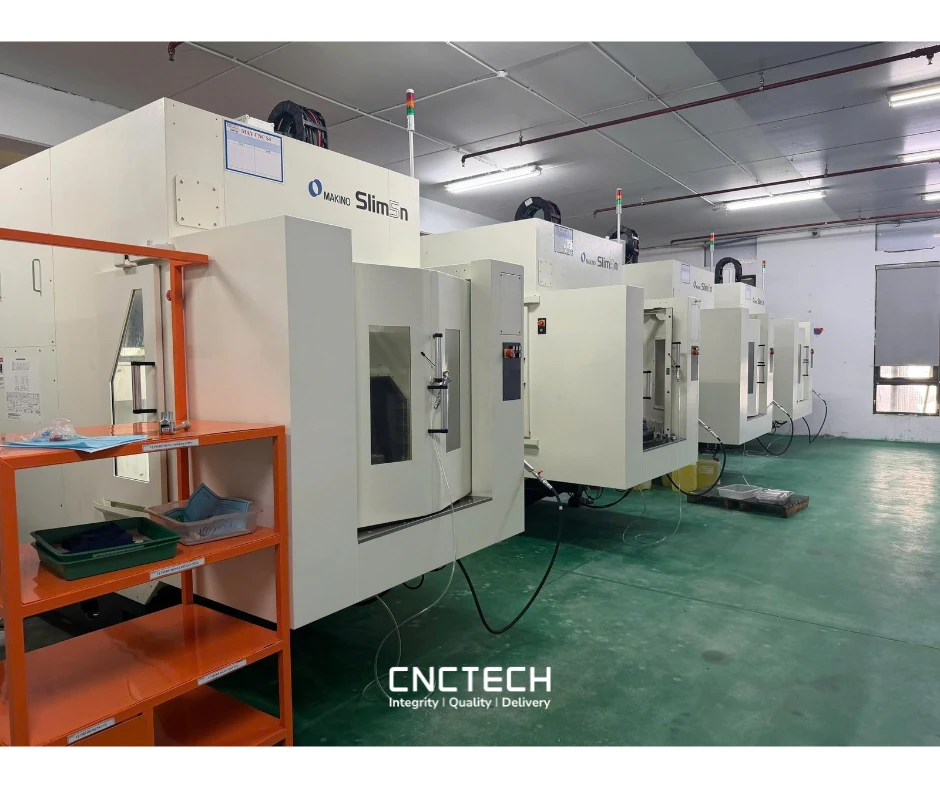
(CNCTech operates 8 factories with more than 60,000 m² of production space and over 400 machining centers, supporting customers across international markets)
Also determine which processes are performed in-house and which are subcontracted, such as heat treatment, plating, anodizing, or other special processes. If external suppliers are involved, ask how they are qualified, monitored, and controlled.
→ CNCTech’s integrated manufacturing model can reduce coordination across multiple specialized suppliers. Explore CNCTech’s Integrated Manufacturing capabilities.
Material traceability can be particularly important for quality-critical products. Verify material grade, certificates, lot or batch identification, and controls against unauthorized substitutions. The required level of traceability should match the product, industry, and customer requirements.
4. Communication, engineering changes, and IP protection
Manufacturing partnerships involve technical decisions, production updates, engineering changes, and problem solving. Communication should therefore be evaluated before the first order.
Look for a clear point of contact, responsive technical communication, document control, and a defined engineering change process. Ask how the supplier controls drawing revisions, removes obsolete documents from production, and handles work-in-progress or finished goods when a design changes.
Intellectual property should also be addressed before sharing sensitive information. Review NDA procedures, CAD and drawing access, document permissions, and controls for proprietary information.
A useful indicator is how a supplier handles technical questions before receiving an order. Clear questions, practical suggestions, and early identification of potential issues often reveal more about the future working relationship than a polished company presentation.
5. Cost transparency and total value
Price matters, but the lowest unit price does not necessarily mean the lowest manufacturing cost.
When comparing quotations, consider:
Tooling, fixture, setup, and NRE costs
Material costs
Surface finishing and secondary operations
Inspection and documentation
Packaging and logistics
MOQ and tooling replacement costs
Potential rework and scrap risks
Ask suppliers to explain what is included in the quotation and which costs may arise later. Compare suppliers based on total value and total landed cost—not unit price alone.
How to evaluate and select a contract manufacturing partner?
Step 1: Build a shortlist based on fit
Identify several potential manufacturing partners with relevant processes, equipment, quality systems, engineering capabilities, and production capacity. Avoid choosing suppliers based only on location or initial pricing.
Step 2: Send the same technical package
Provide shortlisted manufacturers with consistent drawings or CAD files, materials, tolerances, finishing requirements, expected volumes, quality requirements, and target timelines. This creates a fair basis for comparing quotations and technical responses.
Step 3: Go beyond the RFQ
A quotation cannot demonstrate how a supplier will perform in production. Ask each manufacturer to explain its proposed process, DFM feedback, critical quality controls, tooling requirements, inspection methods, lead time, and potential production risks.
If practical, conduct a factory audit. Review actual production flow, equipment, inspection areas, material storage, traceability, calibration, work instructions, maintenance, and controls for non-conforming products. Verify that shop-floor practices match the supplier’s documented procedures.
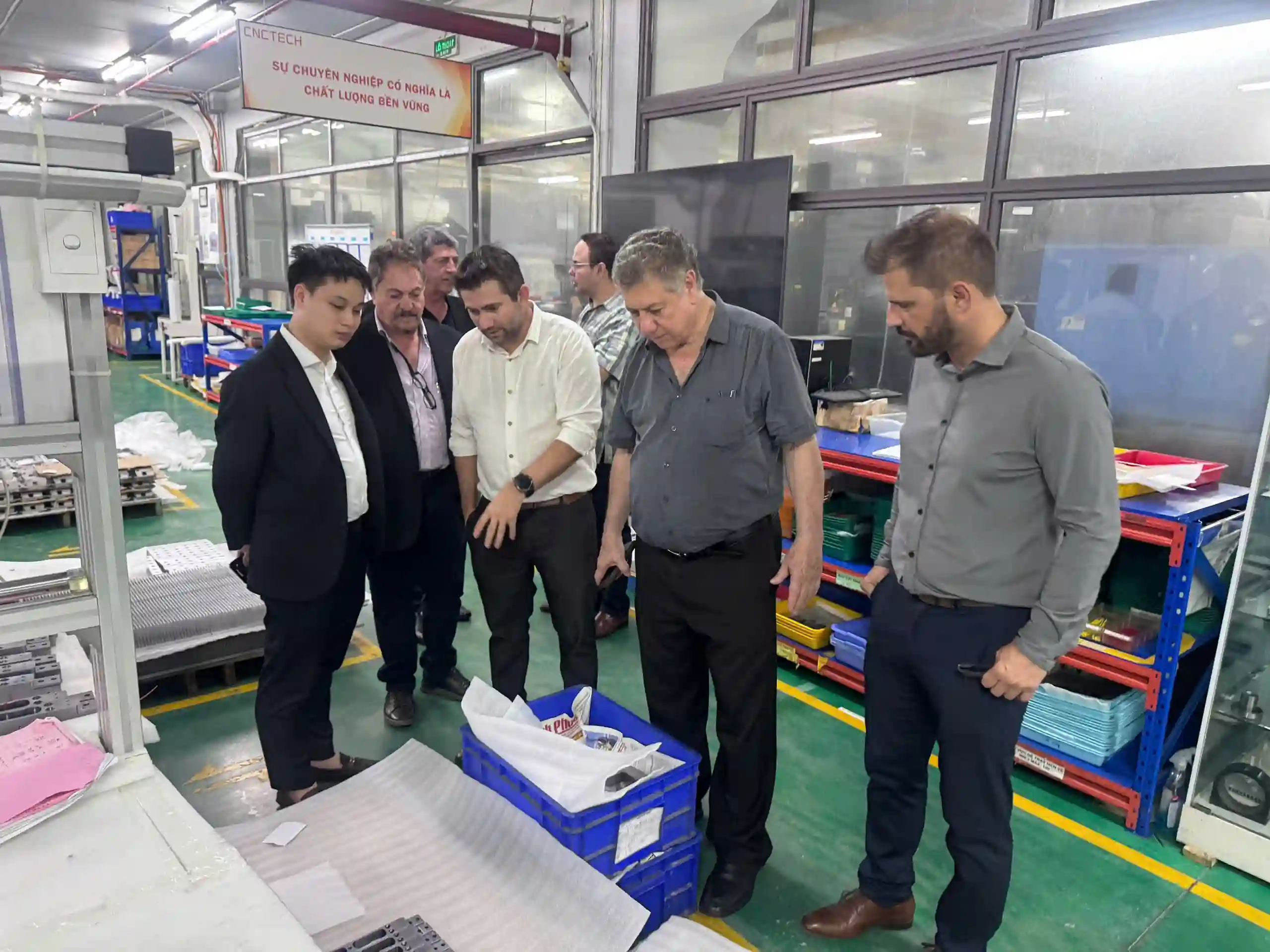
(CNCTech's partner visiting CNCTech Thang Long manufacturing facility)
→ Want to see how your potential manufacturing partner operates? Book a factory tour now.
Step 4: Validate the manufacturer with a prototype, FAI, or pilot run
Before committing to large production volumes, use the appropriate validation stage. A prototype may be used to validate design or manufacturability, while FAI verifies the first production article against defined requirements. A pilot run can provide evidence that the intended production process can deliver consistent results under representative conditions.
Review:
Dimensional and functional conformity
Material and surface-finish requirements
FAI or inspection documentation
Process capability for critical characteristics
Lead time and delivery performance
Problem solving and corrective actions
Ability to manage engineering changes
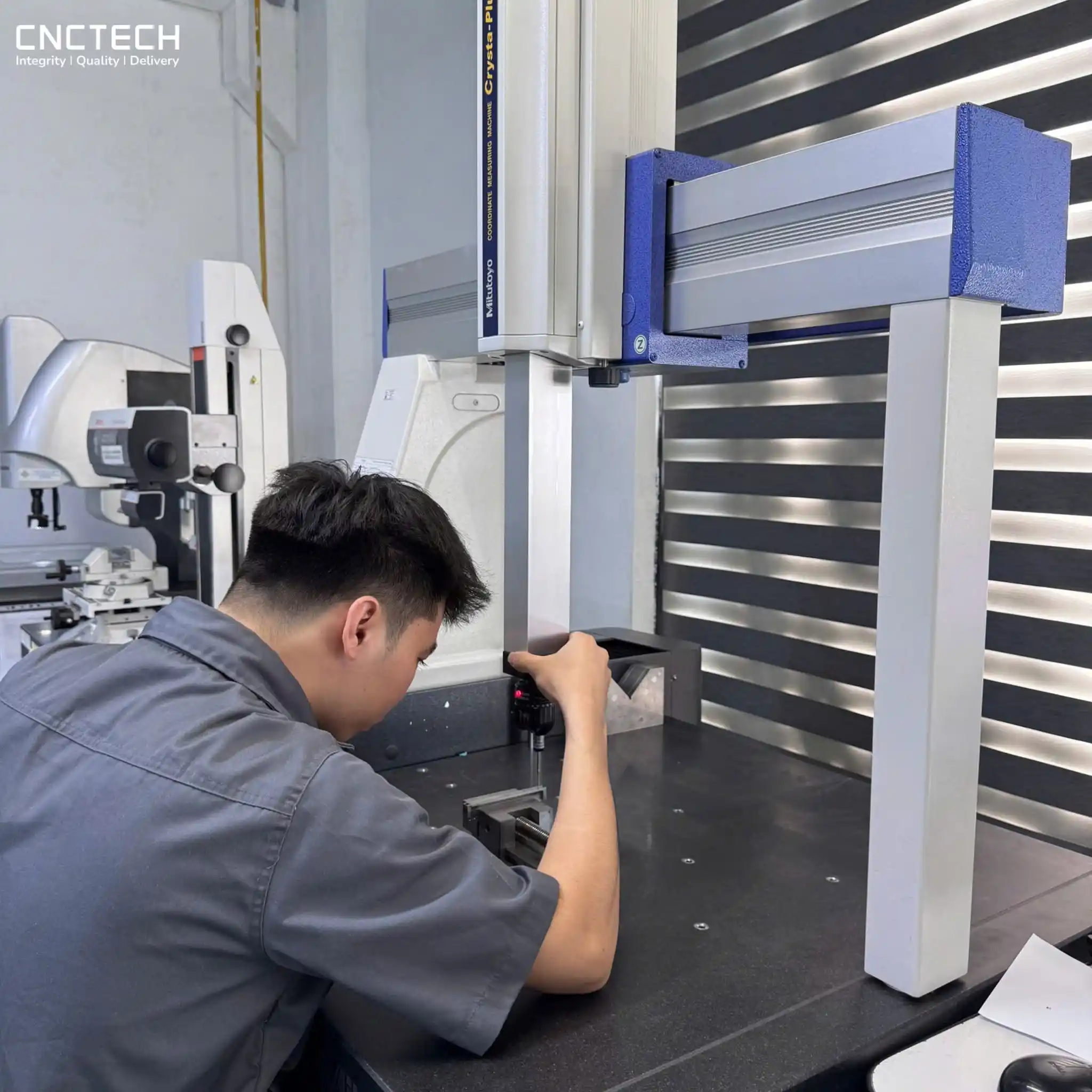
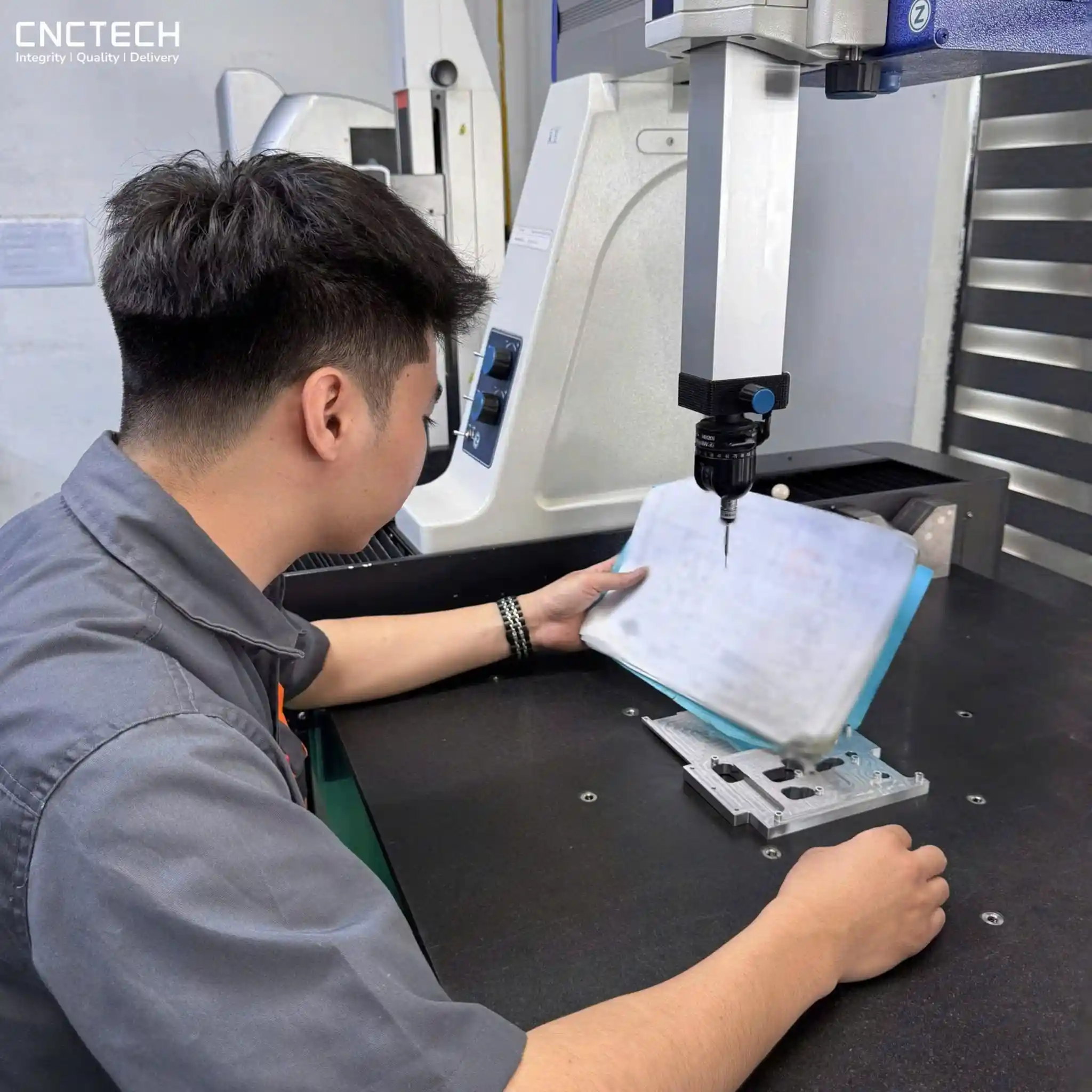
(CMM inspection of a CNC machined part during First Article Inspection)
→ A real production case can help illustrate what this validation looks like in practice. See how CNCTech handled a high-precision CNC machining project for an energy component.
Step 5: Approve and monitor supplier performance
Manufacturing partner qualification should not end after the first production approval. Track indicators such as on-time delivery (OTD), defect or PPM rate, non-conformance rate, corrective-action response and closure, lead time, and cost performance.
Periodic supplier reviews and requalification may also be appropriate when products, processes, or risk levels change.
A simple framework for comparing partners
Score each manufacturer against the same criteria:
Capability: Can they manufacture the product to specification?
Quality: Can they demonstrate consistent process control?
Capacity: Can they support current and future volumes?
Supply Chain: Can they provide reliable materials and delivery?
Collaboration: Can engineering and procurement teams work effectively with them?
Risk: Can they manage disruptions, subcontractors, and engineering changes?
Value: Does the total cost and service level make sense?
Red flags when choosing a contract manufacturer
Be cautious when a potential contract manufacturer:
Offers an unusually low price without a clear cost breakdown
Claims broad capabilities but cannot provide relevant evidence
Gives vague answers to technical or quality questions
Cannot demonstrate how critical dimensions are controlled
Relies on certifications without explaining process controls
Cannot clearly explain capacity or scaling plans
Has weak material or document traceability
Communicates poorly during evaluation
If a supplier is difficult to evaluate before the first order, managing the relationship after production begins may be even harder.
Why choose CNCTech as your contract manufacturing partner?
For global OEMs looking for an integrated manufacturing partner in Vietnam, CNCTech combines multiple production capabilities with large-scale manufacturing infrastructure.
Its capabilities include precision CNC machining, tooling and molding, injection molding, sheet metal fabrication, surface treatment, automation and integration, and EMS/OEM/ODM services. This integrated model can reduce the need to coordinate multiple specialized suppliers while supporting different stages of a product’s manufacturing lifecycle.
CNCTech operates 8 factories with more than 60,000 m² of production space and over 400 machining centers, supporting customers across international markets. Its structured quality-control processes and measurement systems help verify dimensional and quality requirements throughout production.
With 300+ global customers across 35+ countries, CNCTech also has experience working with international customers and manufacturing requirements across different markets. Its engineering and manufacturing capabilities can support projects from technical review and prototyping through production, depending on project requirements.
If you are evaluating manufacturing partners for a new product or production transfer, CNCTech’s team can review your drawings, materials, volumes, quality requirements, and target timeline to determine a suitable manufacturing solution.
→ Ready to evaluate your manufacturing project? Talk to CNCTech’s engineers.
Conclusion
Choosing the right contract manufacturing partner requires more than comparing quotations. Define your technical requirements, verify manufacturing and quality capabilities, assess process consistency and capacity, understand subcontracted processes, evaluate supply chain and engineering-change controls, and validate performance through the appropriate prototype, FAI, or pilot stage.
The right partner should be able to manufacture your product to specification, demonstrate consistent quality, support engineering changes, scale with demand, and provide reliable long-term value. For OEMs exploring manufacturing in Vietnam, a structured supplier qualification process can reduce manufacturing risk and create a stronger foundation for long-term production.
Contact information
Email: hello@cnctech.vn
Phone: (+84) 868 208 111
Corporate Website: https://cnctech.com.vn/
Manufacturing Technology Website: https://cnctech.com.vn/manufacturing
Linkedin: linkedin.com/company/cnctech-manufacturing-technology
Tiktok: https://www.tiktok.com/@cnctechmanufacturing
Youtube: https://www.youtube.com/@cnctech-vn

Tin tức liên quan