SURFACE FINISHING FOR PRECISION PARTS: AN ENGINEERING SELECTION GUIDE


Selecting the right surface finishing for precision parts is essential to achieving the desired balance between performance, durability, appearance, and manufacturing cost. While precision machining produces accurate dimensions, the finished surface ultimately determines how a component withstands corrosion, wear, chemicals, and daily operating conditions.
This engineering guide explains the fundamentals of surface finishing, compares the most common finishing methods, and provides practical selection criteria to help engineers and sourcing teams choose the right process for their application.
What is surface finishing and why does it matter?
Surface finishing is any post-processing operation applied after machining to improve a part's appearance, durability, or functional performance. Depending on the application, it can increase corrosion resistance, reduce wear, enhance surface hardness, improve aesthetics, or prepare a component for assembly.
Choosing the right finish is just as important as selecting the right material or machining tolerance. An unsuitable finishing process can shorten product lifespan, increase maintenance costs, or even affect assembly accuracy.
Choosing the appropriate surface finish offers several engineering benefits:
Improve corrosion resistance in harsh environments
Increase wear resistance for moving components
Enhance cosmetic appearance and product consistency
Support electrical or thermal performance requirements
Prepare surfaces for assembly, bonding, or laser marking
Extend product service life while reducing maintenance costs
Rather than selecting a finish based solely on appearance, engineers should first identify the component's functional requirements. For example, an outdoor aluminum enclosure may require anodizing to resist corrosion, while a stainless steel medical component may benefit from passivation to improve surface cleanliness and corrosion resistance without affecting dimensional accuracy.
Ultimately, the best surface finish is one that balances performance, manufacturability, and cost for the intended application.
Engineering Tip: Consider surface finishing during the design phase rather than after machining. Early planning helps avoid unnecessary rework, ensures coating thickness is accounted for in tolerance calculations, and reduces overall production risk.
Surface finish vs. surface roughness: What's the difference?
Although often confused, surface finish and surface roughness refer to different characteristics of a manufactured part.
Surface roughness describes the microscopic texture created during machining and is typically specified using Ra (Average Roughness) values, a commonly used parameter defined in international surface texture standards. Surface finishing refers to the secondary treatment applied after machining to improve functional or cosmetic properties.
Surface Roughness | Surface Finishing |
Created during machining | Applied after machining |
Measured using Ra values | Defined by the finishing process |
Influenced by cutting tools, feeds, and speeds | Influenced by coating or treatment methods |
Determines surface texture | Enhances functional or cosmetic performance |
A precision-machined aluminum housing, for example, may achieve a surface roughness of Ra 1.6 μm after CNC machining. If the component requires additional corrosion protection, it can then undergo clear anodizing. It does not replace the original machining roughness specification, although the anodizing process may slightly alter the measured surface roughness.
Explore CNCTech’s CNC machining services at: https://cnctech.com.vn/en/precision-machining
For this reason, engineering drawings often specify both requirements independently, such as:
Surface Roughness: Ra 1.6 μm
Surface Treatment: Type II Clear Anodizing
Keeping these specifications separate helps manufacturers deliver components that meet both dimensional and performance expectations.
Engineering Tip: A lower Ra value does not automatically provide better corrosion resistance, just as applying a protective coating does not guarantee a smoother machined surface. Surface roughness and surface finishing should always be specified independently.
What factors should engineers consider before selecting a surface finish?
The right surface finish depends on five key factors: material compatibility, operating environment, functional requirements, dimensional tolerance, and production cost. Evaluating these factors together helps engineers improve product performance while avoiding unnecessary manufacturing complexity or expense.
Rather than asking "Which surface finish is the best?", engineers should ask:
"Which surface finish best meets the functional requirements of this specific part?"
The table below summarizes the primary considerations before selecting a finishing process.
Selection Factor | Why It Matters | Questions to Ask |
Material | Not every finish is compatible with every metal. | Is the part aluminum, steel, stainless steel, or brass? |
Environment | Operating conditions determine the level of protection required. | Will the part be exposed to moisture, chemicals, UV, or salt spray? |
Function | Different finishes improve different properties. | Is corrosion resistance, wear resistance, conductivity, or appearance the priority? |
Tolerance | Some finishes add coating thickness. | Will the coating affect hole sizes, threads, or mating surfaces? |
Cost & Lead Time | Higher performance often increases processing time and cost. | Does the application justify a premium finishing process? |
For example, an aluminum enclosure used indoors may only require standard anodizing, while an outdoor component exposed to humidity and UV radiation will need a finish that provides greater environmental protection. Likewise, decorative parts and high-wear mechanical components often require different treatments, even if they are made from the same material.
Explore the machining characteristics of different materials: A Guide to CNC Machining Materials Selection
Considering these requirements early in the design phase reduces the risk of redesign, rework, and unexpected manufacturing costs.
Engineering Tip: Define the component's functional requirements before selecting a surface finish. Performance requirements-not aesthetics-should drive the decision.
Common surface finishing methods for precision parts
Different finishing methods provide different levels of protection, durability, and appearance. The best choice depends on the application rather than the process itself.
The following comparison summarizes the most common finishing methods used for precision machined parts.
Process | Suitable Materials | Key Benefits | Typical Applications |
Anodizing | Aluminum | Excellent corrosion resistance, decorative finish | Consumer electronics, industrial housings |
Hard Anodizing | Aluminum | Superior wear resistance and surface hardness | Automation equipment, mechanical components |
Electroless Nickel Plating | Steel, stainless steel, aluminum, copper alloys | Uniform coating, corrosion resistance, improved wear resistance and lubricity | Precision mechanical parts, molds |
Black Oxide | Carbon steel | Light corrosion protection with minimal dimensional change | Fixtures, tools, machine components |
Passivation | Stainless steel | Removes free iron and improves corrosion resistance | Medical devices, food processing equipment |
Powder Coating | Steel, aluminum | Durable decorative coating with excellent weather resistance | Machine frames, industrial enclosures |
Bead Blasting | Most metals | Uniform matte appearance and surface preparation | Cosmetic components, pre-coating treatment |
Anodizing
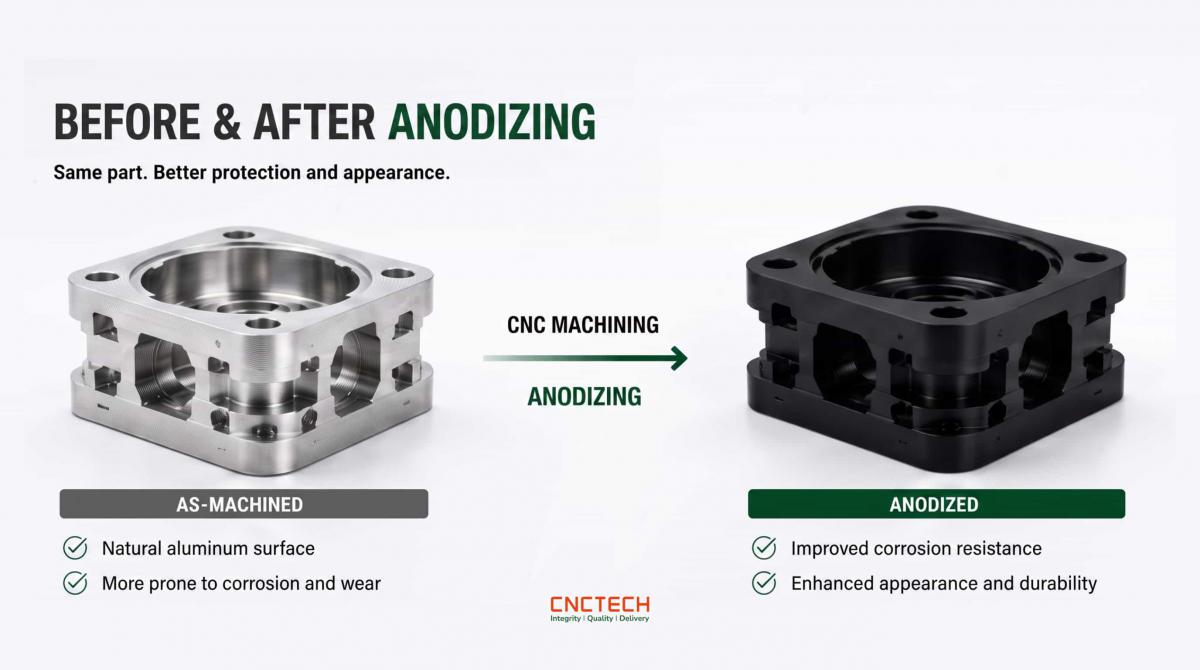
Anodizing is one of the most common finishing methods for aluminum components. It creates a protective oxide layer that improves corrosion resistance while allowing parts to be dyed in various colors. It is widely used for electronic enclosures, consumer products, and industrial equipment.
Hard Anodizing
Hard anodizing produces a thicker and harder oxide layer than conventional anodizing, making it suitable for components subjected to repeated friction or abrasive environments. It is commonly used in automation equipment, tooling, and high-wear mechanical parts.
Electroless Nickel Plating
Unlike conventional electroplating, electroless nickel plating deposits a uniform coating without requiring an electric current. It offers excellent corrosion resistance, improved wear performance, and consistent coating thickness, making it ideal for complex geometries and precision components.
Black Oxide
Black oxide is a chemical conversion coating primarily applied to carbon steel components. Unlike plating or painting, it creates a thin protective layer without significantly changing part dimensions, making it suitable for precision components with tight tolerances.
While black oxide provides only moderate corrosion resistance on its own, it is often combined with oil or wax treatments to improve durability.
Best for:
Precision fixtures
Cutting tools
Machine components
Industrial equipment
Passivation
Passivation is a chemical treatment used for stainless steel to remove free iron and contaminants from the surface. Instead of adding a coating, it enhances the material's natural corrosion resistance by promoting formation of a stable chromium oxide passive layer, following widely adopted industry practices such as ASTM A967.
Because it does not noticeably change dimensions or appearance, passivation is commonly specified for high-precision stainless steel components.
Best for:
Medical devices
Food processing equipment
Semiconductor components
Precision instruments
Powder coating
Powder coating applies a durable polymer layer that provides excellent protection against weather, chemicals, and impact while delivering an attractive, uniform appearance. The process is widely used across industrial manufacturing due to its durability and environmental advantages over conventional liquid coatings. Compared with conventional liquid paint, powder coating generally offers better durability and a wider range of color options.
For more information on the sustainability advantages of powder coating, see the Powder Coating Institute's sustainability resources: Sustainability & Powder Coating: A Lifecycle Perspective
However, its relatively thick coating makes it less suitable for components with very tight dimensional tolerances.
Best for:
Machine frames
Industrial enclosures
Sheet metal parts
Outdoor equipment
Explore our Sheet Metal Fabrication capabilities to see how we combine fabrication, welding, and surface finishing in one streamlined manufacturing process.
Bead blasting
Bead blasting uses fine glass beads to create a clean, uniform matte finish. It is commonly performed before anodizing or painting to improve surface consistency, although it can also serve as the final finish for decorative components.
Because bead blasting mainly improves appearance rather than corrosion resistance, it is often combined with another finishing process.
Best for:
Consumer products
Electronic housings
Decorative aluminum parts
Surface preparation before coating
Comparison of common surface finishing methods
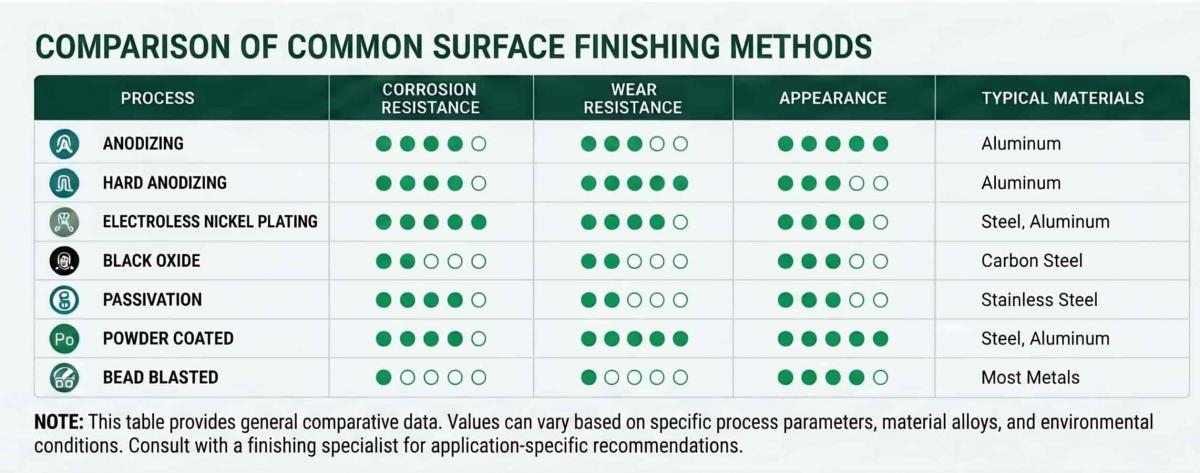
Engineering Tip: No single finishing method is suitable for every application. Always select the process that best matches the component's material, operating environment, and performance requirements.
How to choose the right surface finish
The best surface finish depends on what the part needs to do—not simply how it should look. Start by defining the operating conditions and functional requirements, then select the finishing process that provides the required performance without adding unnecessary cost.
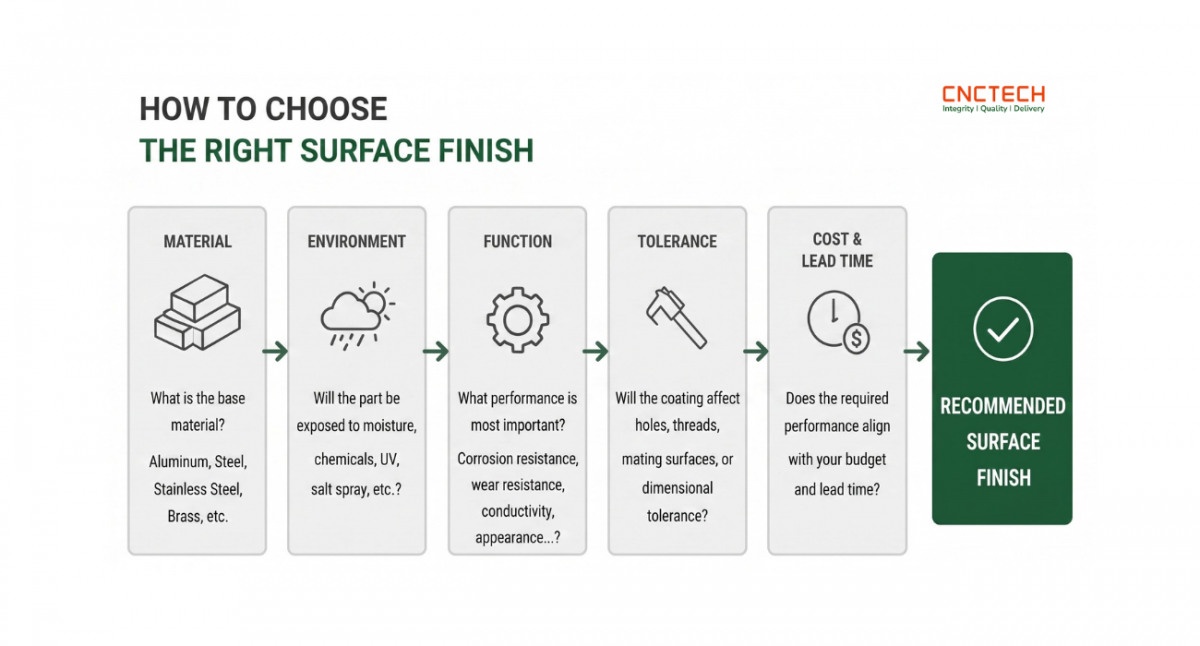
The matrix below provides a quick reference for common engineering applications.
Application | Recommended Finish | Primary Benefit |
Outdoor aluminum enclosure | Anodizing | Corrosion resistance |
High-wear aluminum component | Hard Anodizing | Surface hardness |
Precision mold or tooling | Electroless Nickel Plating | Wear and corrosion resistance |
Stainless steel medical component | Passivation | Clean, corrosion-resistant surface |
Machine frame | Powder Coating | Durability and appearance |
Carbon steel fixture | Black Oxide | Dimensional stability |
Decorative aluminum housing | Bead Blasting + Anodizing | Uniform appearance and protection |
Instead of choosing the highest-performance finish by default, engineers should evaluate the trade-offs between functionality, dimensional requirements, manufacturing cost, and production volume. A finish that is ideal for aerospace equipment may be unnecessary for general industrial applications.
Selection by Engineering Priority
While each finishing process offers unique advantages, engineers often start by identifying the primary performance objective of a component. The table below provides a quick reference for selecting a finishing method based on engineering priorities.
If Your Priority Is... | Recommended Finish |
Maximum corrosion resistance | Electroless Nickel Plating, Anodizing |
Highest wear resistance | Hard Anodizing |
Best cosmetic appearance | Powder Coating |
Maintain tight dimensional tolerance | Passivation, Black Oxide |
Wear resistance with uniform coating thickness | Electroless Nickel Plating |
Surface preparation before coating | Bead Blasting |
Cost-effective protection | Black Oxide |
Common mistakes when selecting surface finishes
Many surface finishing issues originate during the design stage rather than in manufacturing. Selecting a finish based solely on appearance or overlooking factors such as coating thickness and operating environment can lead to unnecessary costs, assembly problems, or reduced product performance.
The following are some of the most common mistakes engineers should avoid.
Common Mistake | Potential Impact |
Choosing a finish based only on appearance | Performance may not meet application requirements. |
Ignoring coating thickness | May affect holes, threads, and mating components. |
Using the same finish for every application | Increases manufacturing costs unnecessarily. |
Overlooking environmental conditions | Higher risk of corrosion or premature wear. |
Failing to specify finishing requirements on drawings | Miscommunication and inconsistent production quality. |
By considering finishing requirements early in the product development process, engineers can improve manufacturability while minimizing production risks.
Why choose CNCTech for precision machining and surface finishing?
Selecting the right surface finish is only part of delivering a high-quality component. Consistent results also depend on the manufacturer's machining capability, process control, and quality management.
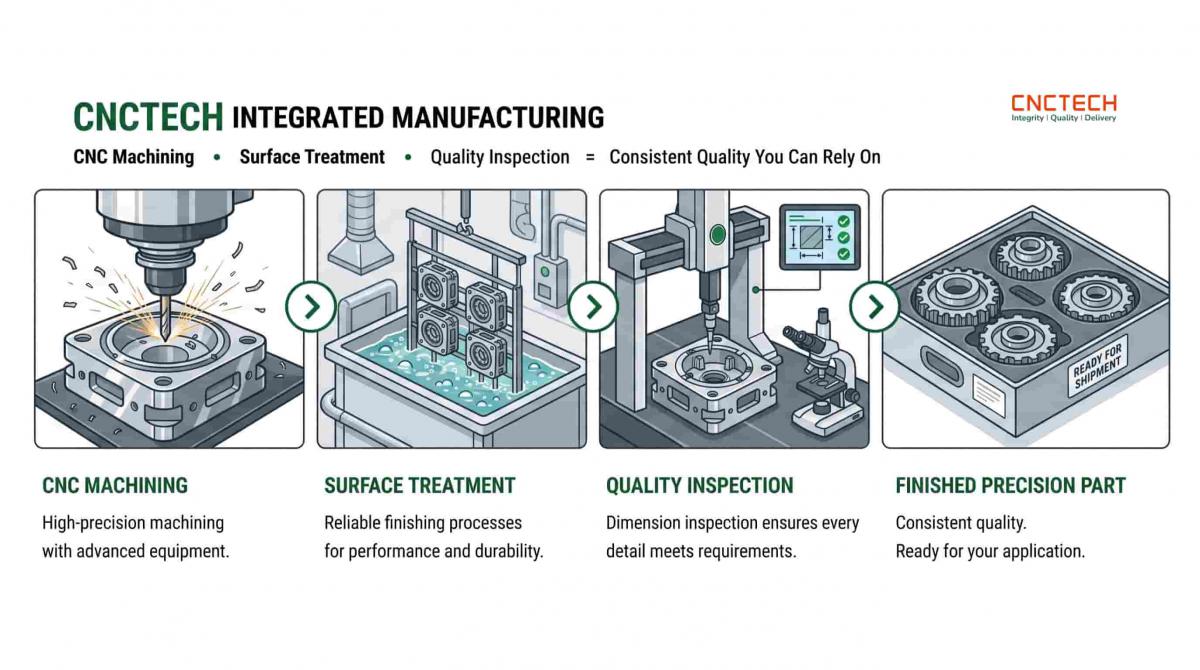
CNCTech provides integrated CNC machining and surface treatment services, enabling customers to simplify supplier management by sourcing precision parts and surface treatment from a single manufacturing partner. Our surface treatment capabilities include powder coating, spray painting, Type II anodizing, Type III hard anodizing, chromate conversion coating (Alodine), silk screen printing, and sandblasting to meet a range of functional and cosmetic requirements.
To support consistent surface treatment quality, CNCTech operates separate powder coating treatment processes for aluminum and steel, using Chromium (III) treatment for aluminum and zinc phosphate for steel. Our Type II anodizing is available in Class 1 and Class 2, with coating thickness from 5 to 22 μm, while Type III hard anodizing is available from 25 to 40 μm.
Whether supporting prototype development or high-volume production, CNCTech combines precision machining and surface treatment capabilities to support the manufacturing requirements of customers across industries such as electronics, industrial equipment, automotive, and automation.
Explore our Surface Treatment capabilities to learn more about the finishing processes available for different materials and applications.
Frequently asked questions
What is the best surface finish for aluminum parts?
It depends on the application. Standard anodizing is ideal for corrosion resistance and appearance, while hard anodizing is better for components requiring greater wear resistance and hardness.
Does surface finishing affect dimensional accuracy?
Yes. Processes such as anodizing, plating, and powder coating add coating thickness that may affect threads, holes, and precision fits. These changes should be considered during the design stage.
What does Ra mean in machining?
Ra (Average Roughness) measures the average surface roughness produced during machining. It is specified independently from the surface finishing process.
How do I choose the right surface finish?
Evaluate the material, operating environment, functional requirements, dimensional tolerance, and budget before selecting the most suitable finishing method.
Conclusion
Choosing the right surface finish is essential for improving product performance, durability, and manufacturing efficiency. By considering material, application, and functional requirements early in the design process, engineers can select a finishing method that delivers the best balance between performance, cost, and manufacturability.
With integrated CNC machining, surface treatment, and quality inspection capabilities, CNCTech helps customers streamline production and deliver precision parts that meet demanding industry requirements.
-----------------------------------------------
Contact information
Email: hello@cnctech.vn
Phone: (+84) 868 208 111
Corporate Website: https://cnctech.com.vn/
Manufacturing Technology Website: https://cnctech.com.vn/manufacturing
Linkedin: linkedin.com/company/cnctech-manufacturing-technology
Tiktok: https://www.tiktok.com/@cnctechmanufacturing
Youtube: https://www.youtube.com/@cnctech-vn

Tin tức liên quan