Crossing the "Valley of Death": How Vietnamese Firms Are Preparing for the Chip Era, and Why R&D Is the Key to Foreign Investment


Split the semiconductor value chain into six stages: product definition, system design, detailed design, fabrication, packaging and testing, and integration and testing. Until this year, Vietnam was present in five of them. The missing link was fabrication. The groundbreaking of the country's first chip fabrication plant at Hoa Lac in January began to fill that gap.
Being in the chain is not the same as owning it, though. Semiconductor revenue in Vietnam already exceeds USD 20 billion, but the value truly created here is still modest. Vietnamese engineers do excellent work on the tasks they are given. Too often, though, the problem belongs to someone else, the tools belong to someone else, and the intellectual property ends up with someone else.

No one is big enough to go alone
That is why an alliance of State, universities, research institutes and enterprises matters. A strong research group has a few dozen people and a handful of instruments. Even a good company cannot fund basic research for ten years on its own. When they pool equipment, design libraries, people and, above all, orders, they suddenly reach a scale where real work becomes possible.
Each side solves one part of the same problem. Companies cannot sustain basic research, and universities cannot commercialise on their own. The State shapes the ground: it places orders, shares the risk on first-of-a-kind products and funds shared infrastructure no single player could afford. The value of the partnership is not in the signing ceremony. It is in shortening the time from idea to a product that sells.
The gap nobody owns
The hardest part sits in what engineers call the "valley of death." A lab can prove a principle: the chip works, the sensor measures correctly. But companies do not buy principles. They need a product that runs reliably for thousands of hours, can be mass-produced at a competitive cost and comes with a warranty. Closing that gap is the most expensive and time-consuming step, and today almost no organisation in Vietnam specialises in it.
CNCTech: building the bridge from the industry side
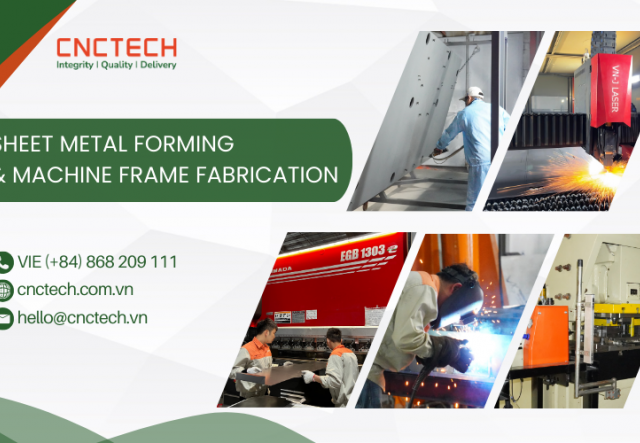
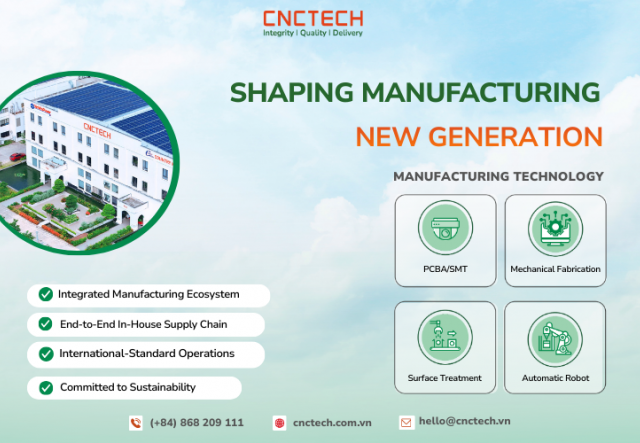
This is where manufacturers like CNCTech Group come in. The group has spent years supplying precision components, machine frames and equipment assemblies to semiconductor customers in Korea, Singapore, Japan and the U.S. It now runs nine factories serving customers in 35 countries, and it is developing industrial parks designed for semiconductor investors.
Its next step is R&D. By working with university labs on long-horizon problems (new materials, new processes, solutions for challenges three to five years out), CNCTech is building the design capability and IP that let a supplier move up from contract manufacturing. The same partnerships target talent: today new graduates typically need 6–12 months of retraining, and industry–university programmes aim to cut that to 2–3 months.
Why foreign investors should care
For a global chip company looking at Vietnam, land and labour are no longer enough. What reduces risk is a local partner that can co-develop, prototype, qualify and scale, with access to university research and a steady supply of industry-ready engineers. R&D capability is what turns a supplier into a partner, and a partner is what brings the next wave of investment.
The message from industry to academia is simple: companies are not looking for another report. They are looking for teams that can solve, together with them, the problems the market is setting today.
Where do you see the biggest gap in Vietnam's "valley of death": funding, pilot-scale facilities or people?
Contact information
Email: hello@cnctech.vn
Phone: (+84) 868 208 111
Corporate Website: https://cnctech.com.vn/
Manufacturing Technology Website: https://cnctech.com.vn/manufacturing
Linkedin: linkedin.com/company/cnctech-manufacturing-technology
Tiktok: https://www.tiktok.com/@cnctechmanufacturing
Youtube: https://www.youtube.com/@cnctech-vn

Tin tức liên quan