Sheet Metal Forming for Industrial Manufacturing | Cutting, Bending, Welding & Finishing (CNCTech Guide)


Sheet Metal Forming for Industrial Manufacturing
A Technical Guide to Cutting, Bending, Welding, and Surface Finishing
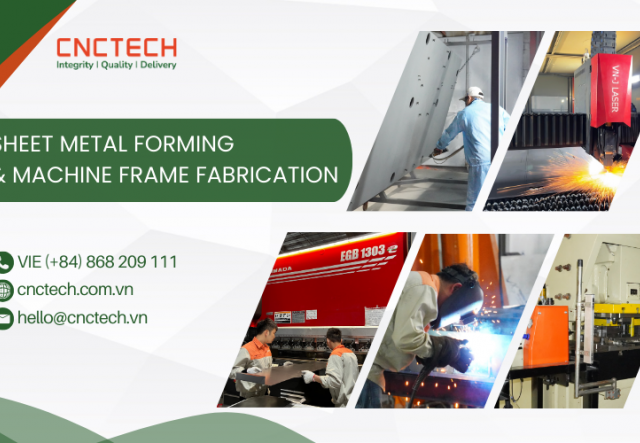
Sheet metal forming is one of the fastest paths from concept to production for industrial products—especially when programs demand scalability, consistent quality, and cost efficiency. From equipment enclosures and electrical cabinets to structural chassis and machine frames, well-executed sheet metal fabrication reduces assembly complexity and supports stable production ramps.
I. SHEET METAL FORMING
Products
- Machine/equipment panels
- Equipment Enclosures
- Brackets
- Electrical cabinets
- Structural chassis
Material: Carbon steel, stainless steel, aluminum and copper. …
Process
a. Cutting technologies

- Fiber Laser: Laser is generated through fiber optic amplification → wavelength ~1.06 µm.Material: Carbon steel, stainless steel, aluminum, copper, etc.
- CO2 Laser: Older technology; laser is generated from CO₂ gas → wavelength 10.6 µm.
Material: Carbon steel (20–25 mm), Stainless steel (15–20 mm), Non-metal materials (wood, plastic, acrylic, etc.)
- Disk Laser: Thin-disk laser technology; high-end and less common in the market.
- Direct Diode Laser: A newer technology with the highest electrical efficiency, though not yet widely adopted.
Laser Technology Comparison Table
Criteria | Fiber laser | CO₂ laser | Disk Laser | Diode Laser |
Electrical Efficiency | * * * * | * | * * * | * * * * * |
Thin Sheet Cutting Speed | * * * * * | * * | * * * * | * * * * |
Thick Steel Cutting | * * * | * * * * | * * * * | * * * |
Aluminum / Copper Cutting | * * * | * * | * * * * | * * * * |
Accuracy | * * * * | * * * | * * * * | * * * |
Maintenance | Low | High | Medium | Low |
Market Trend | Most Popular | Declining | Hi-end | Emerging |
- SMCTECH’s factory is equipped with a modern Fiber Laser cutting system powered by an IPG (USA) laser source.
IPG Laser source | Carbon steel | Stainless steel | Alu/Copper |
3kW (02) | ~12mm | 8mm | 6mm |
6kW (01) | ~20mm | 16mm | 10mm |
b. Turret Punch
- Products: Electrical cabinets, automation panels, enclosure parts, mass-production sheet components.
- Materials: Carbon steel, stainless steel, aluminum, galvanized steel
- Turret Punch Technology:
Turret punching is a mechanical sheet metal fabrication process where a rotating turret holds multiple punches and die tools. The machine selects tools automatically to punch holes, slots, forms, embossing, and louvers into sheet metal.
Thickness Range: 1.0 to 3.0mm
Advantages
- Very cost-effective compared to laser for high-volume production
- High repeatability and stable quality
- Capable of forming features
- Fast for repetitive hole patterns
Disadvantages
- Limited flexibility for complex contours
- Tooling cost for special shapes
- Burrs may require secondary deburring

Direct comparison
Criteria | Turret Punch | Fiber Laser |
Speed (repetitive holes) | Very High | Medium |
Complex contour cutting | Limited | Excellent |
Forming capability | Yes | No |
Thin sheet cost efficiency | Very High | Medium |
Tooling cost | Required | Not required |
Flexibility | Medium | Very High |
c. Turret punch + laser combinations
This integrated system combines a turret punch and a fiber laser cutting head in one machine platform. The punch performs forming and repetitive holes, while the laser handles complex contours and precise external cutting.
SMCTECH operates an advanced Prima Power punch+laser combination system from Italy, allowing us to efficiently manufacture high-quality components while achieving greater productivity and cost efficiency compared to independent punching or laser cutting processes.
Direct comparison
Criteria | Turret Punch | Turret + Laser Combination |
High Hole Density Parts | Excellent | Excellent |
Risk of Thermal Distortion | None | Very Low |
Complex Outer Profile | Limited | Excellent |
Edge Quality | Medium | Excellent |
Productivity | Medium | Very High |
Flexibility (*) | Medium | Very High |
(*) It saves a lot of time if the product requires both punching and laser cutting.
d. Bending/Forming
Bending/forming is a critical process in sheet metal fabrication, where flat sheet material is shaped into angular or curved geometries using controlled force without removing material.
Material: Steel, stainless steel, aluminum, galvanized steel, copper.
CNC Press brake technology: A CNC press brake uses a punch and die system to apply controlled force and bend sheet metal along a programmed axis.

e. Folding
Folding is a sheet metal forming process used to bend large panels with high precision while minimizing surface marks and deformation.
Unlike traditional press brake bending, folding machines move the sheet while the clamping beam holds the material in place, resulting in superior dimensional stability.
Material: Steel, stainless steel, aluminum, galvanized steel
f. Stamping Press
Stamping is a high-efficiency metal forming process that uses mechanical or hydraulic presses combined with dedicated dies to shape sheet metal into specific geometries.
It is widely used for mass production of precise and repeatable metal components across various industrial sectors.
Material: Steel, stainless steel, aluminum, galvanized steel, copper, brass.

SMCTECH is fully equipped with advanced sheet metal forming technologies to ensure professional handling of designs from various industrial sectors, while optimizing production cost and efficiency.
Criteria | Press Brake | Folding | Stamping (Press Forming) |
Investment Cost | Medium | High | Very High (die cost) |
Tooling Cost | Low–Medium | Low | Very High |
Production Volume | Low–Medium | Medium | Very High |
Flexibility | Very High | High | Low |
Setup Time | Medium | Fast | Long (die setup) |
Surface Protection | Medium | Excellent | Excellent |
Large Panel Capability | Limited | Excellent | Limited |
Thick Material | Excellent | Limited | Medium |
Design Change Adaptability | Very High | High | Very Low |
Unit Cost (Low Volume) | Low | Medium | High |
Unit Cost (High Volume) | Medium | Medium | Very Low |
Automation Level | Medium | High | Very High |
g. Welding

TIG Welding (GTAW – Gas Tungsten Arc Welding)
Material: Stainless Steel, Aluminum, Thin carbon steel
Commonly used for semiconductor equipment and cosmetic-visible parts.
Advantages:
- High precision
- Clean and aesthetic weld seam
- Low spatter
- Ideal for thin materials
Disadvantages:
- Slower process
- Requires skilled operator
MIG Welding (GMAW – Gas Metal Arc Welding)
Material: Carbon steel, Stainless Steel, Medium & Thickness material
Common for machine frame and structural fabrication.
Advantages:
- High productivity
- Strong weld penetration
- Suitable for thicker materials
- Cost-effective
Disadvantages:
- More spatter than TIG
- Lower cosmetic quality (may require grinding)
Laser Welding
Laser welding is a focused laser beam that melts the material at the joint area.
Material: Thin sheet metal, stainless steel, carbon steel, Aluminum, galvanized steel
Advantages:
- Very low thermal distortion
- Narrow weld seam
- High welding speed
- Minimal post-processing required
- Excellent cosmetic appearance
- High precision for thin materials
Disadvantages:
- High equipment investment
- Joint fit-up must be precise
- Not ideal for large gap filling
- Requires safety control due to laser radiation
Spot Welding (Resistance Welding)
Material: Thin sheet metal, overlapping sheet joints
Widely used in cabinet and enclosure production.
Advantages:
- Very fast
- High repeatability
- Ideal for mass production
Disadvantages:
- Limited to thin materials
- Not suitable for structural frames
Robotic Welding
We deploy robotics with MIG welding source for repetitive and large volume production, especially in module welding applications for machine frame manufacturing, ensuring high consistency, productivity, and structural integrity.
Comparison: MIG vs TIG vs Laser Welding
Criteria | TIG | MIG | Laser Welding |
Precision | High | Medium | Very High |
Speed | Low | High | Very High |
Heat Input | Medium | High | Very Low |
Distortion | Medium | Higher | Very Low |
Cosmetic Quality | Excellent | Moderate | Excellent |
Thick Material | Limited | Excellent | Medium |
Automation Capability | Medium | High | Very High |
Investment Cost | Medium | Medium | High |
SMCTECH can provide products in compliance with standards such as:
- AWS D1.1 (Structural welding)
- ISO welding standards
h. Surface treatment
Anodizing
Anodizing is an electrochemical process that increases the thickness of the natural oxide layer on the surface of aluminum. This oxide layer enhances corrosion resistance, wear resistance, and surface hardness.
Main types of anodizing which we provide:
Type II – Sulfuric Acid Anodizing
- Thickness: 5–22 µm
- Decorative and corrosion protection
- Can be dyed (black, clear, etc.)
Type III – Hard Anodizing (Hard Coat)
- Thickness: 25–65 µm
- Very high hardness (up to 60–70 HRC equivalent)
- Used in aerospace and high-wear components
Common standards and compliance:
- MIL-A-8625 (now MIL-PRF-8625)
- RoHS-compliant
Chromate conversion coating (Alodine / Chemical Film)
Chromate conversion coating is a chemical treatment that creates a thin protective film on aluminum surfaces. Unlike anodizing, it does not significantly increase thickness and maintains electrical conductivity.
Thickness
- Very thin layer (~0.2–2 µm)
- Minimal dimensional impact
Common standards and compliance:
- MIL-DTL-5541
- RoHS-compliant versions available (Trivalent chromate)
Comparison: Anodizing vs Chromate Conversion
Criteria | Anodizing | Chromate Conversion |
Corrosion Resistance | High | Medium–High |
Wear Resistance | Very High | Low |
Thickness | 5–70 µm | 0.2–1 µm |
Dimensional Impact | Moderate | Minimal |
Electrical Conductivity | No | Yes |
Surface Hardness | Very High | Low |
Cost | Higher | Lower |
Cosmetic Finish | Decorative options | Industrial appearance |
Suitable for Grounding | No | Yes |
Powder coating
Powder coating is a dry finishing process in which electrostatically charged powder particles are sprayed onto metal surfaces and then cured in an oven to form a durable protective layer.
Spray painting
Spray painting uses liquid paint (epoxy, PU, or other industrial coatings) applied through spray guns in controlled paint booths.
Heavy phosphate coating
Heavy phosphate coating is a chemical surface treatment process that creates a thick crystalline phosphate layer on steel surfaces to improve corrosion resistance and paint adhesion.
Comparison of Surface Finishing Methods
Criteria | Powder Coating | Spray Painting | Heavy Phosphate |
Corrosion Resistance | High | Medium–High | Medium |
Surface Appearance | Excellent | Very Good | Matte/Industrial |
Environmental Impact | Low VOC | Higher VOC | Low |
Suitable for Large Frames | Medium | Excellent | Excellent |
Chemical Resistance | High | High | Medium |
Used as Final Coating | Yes | Yes | Pre-treatment |
II. MACHINE FRAME FABRICATION
Products
- Machine structural frames
- Welding/Assembly Fixture frames
- Integrated system frames
Process
- Cutting
- Turret punch
- Bending
- Welding
- Surface treatment
Contact Us
Email: hello@cnctech.vn
Website: www.cnctech.com.vn
Phone: (+84) 868 208 111

Tin tức liên quan